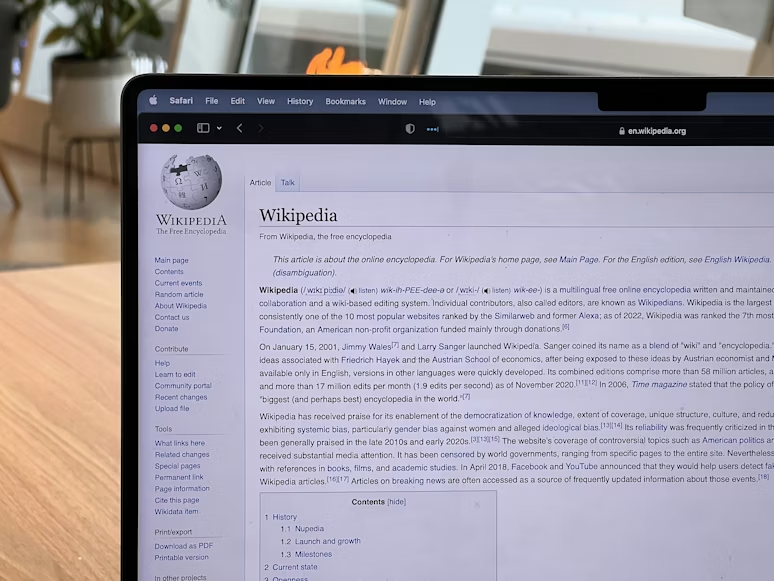
The value of Wikipedia isn’t the article itself. It’s the map it provides.
When people dismiss Wikipedia as unreliable, they miss what it’s actually best at: orientation. The “Wikipedia First” method isn’t about trusting Wikipedia as a final authority; it’s about using it as a launchpad for smarter, faster searching everywhere else.
Search behavior shows that people who start with Wikipedia ask better questions, recognize credible sources more quickly, and spend less time chasing surface-level answers.
Why Most Searches Fail Before They Begin
Most searches fail because people don’t yet know the language of the topic they’re exploring. Wikipedia fixes that problem early.
The first advantage is terminology. Wikipedia articles surface the words experts actually use, such as formal names, alternate terms, and precise labels. Searching with everyday phrasing often returns opinion pieces and listicles. Searching with field-specific terminology returns explanations, studies, and primary sources.
Explore Smarter Searching 101: How to Find What You Need in Half the Time for foundational search framing.
How Wikipedia Solves the Vocabulary Problem
This is why the first step in the Wikipedia First method is skimming, not reading. You’re looking for vocabulary, not conclusions. Headings, bolded terms, and opening paragraphs reveal how the subject is framed academically or professionally.
Once you have the correct language, search quality improves immediately.
Using Article Structure to Learn What Questions Matter
The second advantage is structure. Wikipedia embraces the neutral point-of-view model. Articles are organized to reflect how a topic is understood: background, mechanisms, variations, criticism, and applications. This structure teaches you what questions matter.
Search behavior improves when people follow this structure. Instead of asking one broad question, they break it into parts: how it works, why it exists, what debates surround it, and where it applies.
This prevents the common spiral of reading ten articles that say the same thing in different ways.
See How to Tell If a Search Result Is Trustworthy (Without Being an Expert) for credibility evaluation skills.
How to Mine the References Section for Better Sources
The third, and most underused, advantage is the references section. Wikipedia’s references are not filler. They are curated gateways to higher-quality sources.
Instead of searching the open web for “best source on X,” scrolling the references shows which institutions, journals, and organizations are already considered authoritative on the topic. Clicking through bypasses SEO-heavy summaries and lands you closer to original material.
Search engines reward this shift. Queries that reference institutions, reports, or frameworks surface more reliable content.
Following Linked Concepts to Fill Context Gaps
The fourth advantage is linked concepts. Wikipedia articles are dense with internal links that reveal how ideas connect. These links expose adjacent topics you didn’t know to search for.
Search behavior shows that confusion often comes from missing context, not missing facts. Linked concepts restore that context.
For example, someone searching for a psychological term may not realize it sits within a broader theory or overlaps with other constructs. Wikipedia reveals those relationships immediately.
Following links expands understanding sideways, not just deeper.
Learn How to Find the Original Source of a Quote You See Everywhere for tracing information back to its origins.
Why Wikipedia’s Neutral Tone Improves Judgment
The fifth advantage is neutral tone. Wikipedia is designed to summarize consensus and dispute without urgency. That calmness matters.
Search behavior improves when headlines don’t emotionally activate people. Wikipedia’s tone helps stabilize curiosity before people move into more opinionated spaces.
This makes it especially useful for sensitive topics, such as health, politics, and finance, where emotional framing can distort judgment early.
Learning From Disputed and Incomplete Sections
The sixth advantage is knowing what not to trust. Wikipedia openly marks sections that are disputed, outdated, or incomplete. Those signals teach skepticism.
Learning to notice where knowledge is thin is as vital as learning where it’s strong. Search engines don’t always highlight uncertainty, but Wikipedia does.
That transparency improves downstream searching because users stop expecting definitive answers where none exist.
Read What to Do When Google Isn’t Helping: Alternate Search Tools & Methods for next-step research approaches.
How to Use Wikipedia as a Launchpad, Not a Destination
The Wikipedia First method works best when used deliberately. Start with Wikipedia to learn the language, structure, and source ecosystem. Then leave it.
Search engines work better when users do some of the organizing work first. Wikipedia helps you do that by organizing quickly.
Used this way, Wikipedia isn’t the destination. It’s the compass.